Artists Well-Crafted
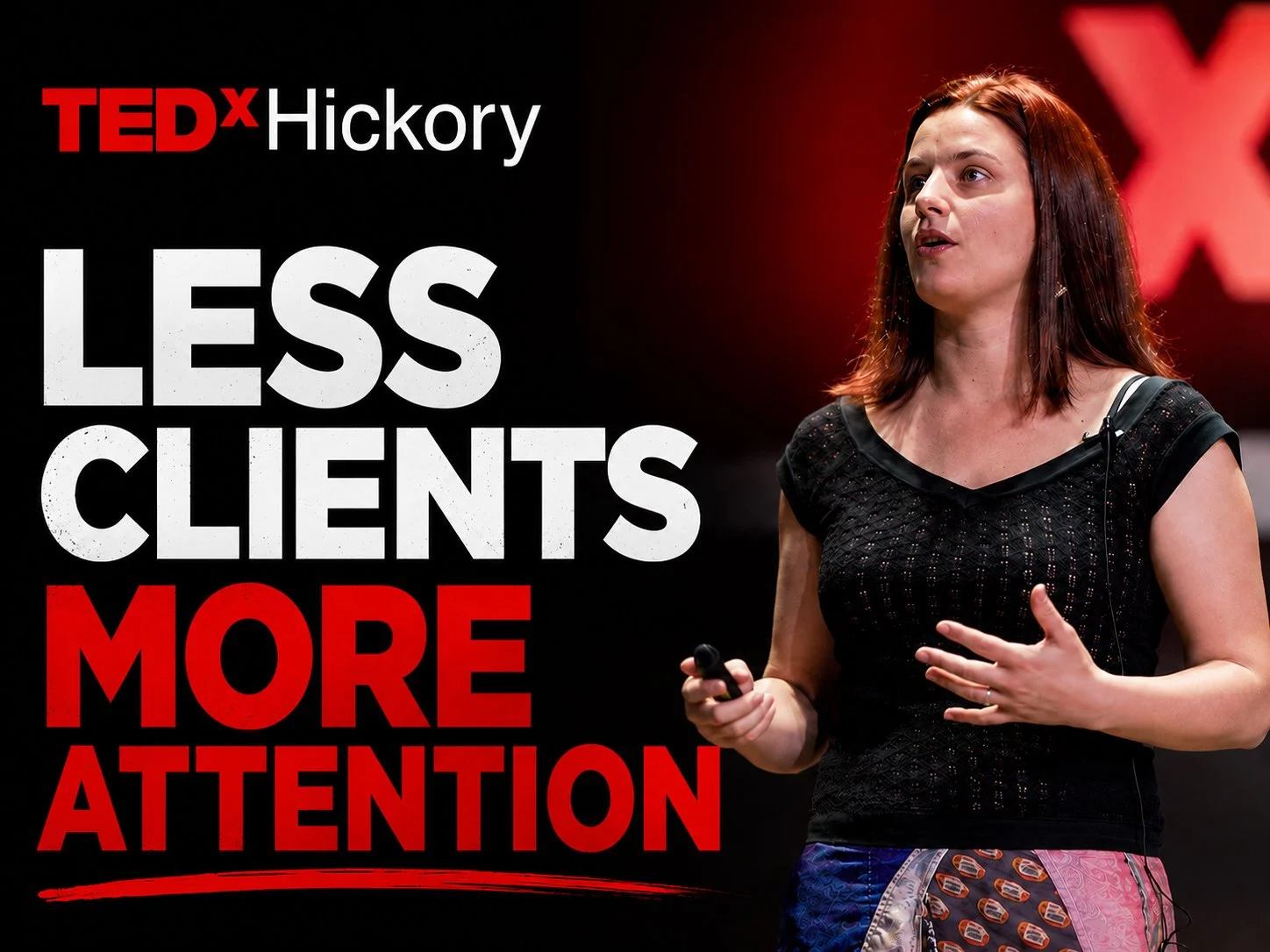
Carol Anne Hartman at TEDxHickory
A 2012 talk about personalized arts education, quality over quantity, authentic relationships, and building a connected creative community in Hickory, NC.
On April 21, 2012, Carol Anne Hartman represented Hickory Arts at TEDxHickory.
At the time, Hickory Arts was a young local school offering instruction in music, acting, performing arts, and visual arts. In her talk, Carol Anne explained the two principles guiding the business:
Fewer clients. More attention.
And:
Build genuine connections with people.
Neither principle is presented as a complicated business secret. Instead, the talk focuses on something businesses can easily lose as they grow: meaningful human relationships.
Carol Anne discusses personalized arts education, Hickory Arts’ original 30/30/30 model, quality over quantity, authentic partnerships, community support, and the idea that businesses can grow by helping people rather than treating them like numbers.
The transcript below has been lightly edited for clarity, readability, and flow while preserving the meaning and present-tense perspective of the original talk.
About the Talk
Event: TEDxHickory
Speaker: Carol Anne Hartman
Original Date: April 21, 2012
Representing: Hickory Arts
Topics: Personalized arts education, quality over quantity, customer relationships, creative community, business partnerships, and human connection
Historical note: Pricing, policies, social media references, and other operational details reflect Hickory Arts as it existed in 2012. Visit our current Services and Scheduling pages for up-to-date information.
Two Principles Behind Hickory Arts
Thank you so much.
I’m here representing Hickory Arts, which is a local school for music, performing arts, acting, and visual arts.
I want to talk about how we run our business.
It is not a new idea. It is not incredibly fancy, and it is not a big secret. But I believe it is an idea that is often overlooked.
As a business moves faster, grows, and begins to pick up steam, this idea can easily get pushed to the back or moved aside.
There are two main facets to the way we run Hickory Arts, and I want to talk about both of them.
The Jerry Maguire Philosophy
We call the first facet the Jerry Maguire philosophy.
You may remember the movie Jerry Maguire from the 1990s. The main character has a moral epiphany and writes a mission statement based on a simple idea:
Fewer clients. More attention.
We originally wanted to show a clip from the movie, but we were not sure we had the legal rights to do that.
Then we considered having actors reenact the scene, but that created another possible copyright issue.
So instead, one of our Hickory Arts actors joins me onstage to offer what we call an “interpretive paraphrasing.”
His first attempt is an enthusiastic variation on “Show me the money.”
It is very good.
It is just jokingly not the scene we discussed.
Eventually, we get to the real point: fewer clients, more attention, and more focus on the people being served.
In the movie, Jerry Maguire writes this philosophy into a mission statement, gets fired, leaves with one client, one coworker, and a goldfish, and starts a new business.
Everything eventually works out because that is Hollywood.
But the underlying idea is how we run our business.
And it works.
Get to Know the People You Serve
This idea is going to look different for every business.
Hickory Arts is part of the service industry. We serve students, but I believe the same principle can work in retail, business-to-business companies, and many other organizations.
The first thing you need to do is get to know the people you serve.
Know who they are.
Know what they like.
Know who they love and what matters in their lives.
I do not mean that in a stalker-like, hiding-in-the-bushes kind of way.
But there is one important condition:
You cannot fake it.
When you give someone attention, you have to mean it.
You cannot fake additional time with clients. You cannot pretend to care simply because you want something from them.
People will see you coming from a mile away.
They will see through it.
You have to commit to the idea completely, or it will backfire.
The Original 30/30/30 Rule
At Hickory Arts, this philosophy is expressed through what we call our 30/30/30 rule:
$30 for a 30-minute weekly lesson
No teacher takes more than 30 private students in a week
We advertise it that way because we want people to understand how we operate.
We limit the number of students because we want our teachers to know them.
We want teachers to understand who their students are, what they need, and what will help them move forward.
It also gives our teachers enough flexibility to remain available. If a student has an issue during the week and needs to call, the teacher has the time and energy to respond.
We adopt the Jerry Maguire philosophy for one simple reason:
We care.
We care about the quality of what we offer, but we also care about our students and the people we serve.
Our product is different from a traditional retail product. It is not tangible.
Our product is the skill, knowledge, and experience our teachers have—and the way they pass those things along to their students.
Artists Well-Crafted
We really like Hickory’s motto:
Life. Well Crafted.
We have fully embraced that idea.
For Hickory Arts, it becomes:
Artists. Well-Crafted.
The Jerry Maguire philosophy encourages craftsmanship.
It encourages individualized craftsmanship.
You have to spend time with people to understand what they need.
It requires time and attention.
That is quite different from a factory.
Students Are Not Products
Factories have their place.
A factory is designed to produce the same thing repeatedly. It creates a consistent, cookie-cutter product.
That works well for factories.
But individualized education and artistic development are different.
Not everyone fits into the same mold.
You cannot use the exact same philosophy or teaching method with every student.
If we fill every available hour on every teacher’s schedule, we eventually have to operate like a factory. There is no longer enough time to understand each student individually.
We have to rely on a cookie-cutter philosophy.
We do not want to do that.
We do not want to create a system that encourages students to fail simply because they do not fit the system.
Quality Over Quantity
Does limiting enrollment restrict us financially?
I do not think it does, for one simple reason:
Loyalty.
Hickory Arts has only been around for about six months at the time of this talk, but our teachers have been teaching much longer than that.
All of our teachers adopt this philosophy. Many of them already use it before joining Hickory Arts, which is one reason we work with them.
They often come to us with students who are fiercely loyal because of the time, attention, and personalized instruction they receive.
We also gain new students through word of mouth.
Parents of younger students appreciate this approach, and they tell other families about it.
It comes down to a simple principle:
Quality over quantity.
The two do not always coexist easily.
When we have to choose between them, Hickory Arts chooses quality.
The first facet of our business is fewer clients and more attention.
Beyond Traditional Networking
The second facet is basically networking, but I prefer to call it connection.
We want to take it further than ordinary networking, basic business interaction, or social media activity.
It is about people.
Even in a business-to-business company, you are still dealing with flesh-and-blood human beings every day.
I am not talking only about LinkedIn, Facebook, or Twitter. Those platforms are important, and we use them.
But the connection has to mean something.
It should matter to the other person as much as it matters to you.
It is not enough to win friends and influence people.
You have to be authentic in your relationships.
You Cannot Manufacture Sincerity
It is not enough to “like” someone on Facebook.
It is not enough to say, “Let’s have lunch next week,” unless you genuinely want to follow through.
You have to care about the people you are connecting with.
Again, you cannot manufacture sincerity.
People can see artificial interest coming.
It is like the overly eager salesperson who learns your name and then uses it in every sentence:
“Hi, Bob.”
“Good to see you, Bob.”
“Come over to the counter, Bob.”
“We’ll fill out the paperwork, Bob.”
“We’ll get you on your way, Bob.”
It leaves you feeling a little uncomfortable.
The salesperson knows your name and wants you to know that he knows your name.
But that may be all he knows about you.
His interest exists because you are doing something that benefits him.
That is not a genuine connection.
Partnerships That Mean Something
There are many ways to create meaningful relationships through a business.
At Hickory Arts, we do not only teach.
We also actively do many of the things we teach.
One way we make connections is by partnering with other businesses. We may provide work for a company and then share that experience publicly:
“We just worked with this fabulous company, and we cannot wait to work with them again.”
They may do the same for us.
What makes that a business connection rather than simple promotion?
We choose to make the connection meaningful.
We maintain the relationship even when we are not actively working together because the people and the relationship matter to us beyond a single project or transaction.
There are also companies we choose not to connect with because we cannot do so authentically.
That does not necessarily mean they are bad companies or that they have a bad product.
Something about their message, their product, or the way they operate may simply not align with us.
If we cannot be genuine in that relationship, we do not create it.
And that is okay.
The power is yours to choose the connections you make and the relationships you maintain.
Give Something Without Keeping Score
Another way to connect is through gifts.
I do not mean walking around with a sack full of iPads and asking people to be your friend.
I am not talking about expensive gifts.
I am talking about something you already have that you can offer to someone else.
That may be advice.
Someone may mention a problem in their business that you have already experienced. You may be able to offer a useful piece of advice that would ordinarily cost them money.
It may be something that is easy for you to do.
I am a photographer. Sometimes I provide photographs for people or organizations I genuinely want to support.
At Hickory Arts, one specific thing we do is work with local community theatres. We create short promotional videos for their musicals.
A two-minute web video takes relatively little time for us to assemble because it is something we already know how to do.
The biggest time commitment is going to the theatre, watching the show, and recording it.
But I get to watch a show, so that is pretty cool too.
We give the finished video to the theatre and say:
“Here. This is for you.”
We expect nothing in return.
We do it because we value our connection with them and want to support the relationship.
Creating a Connection Hub in Hickory
We would love for Hickory Arts—and every business in Hickory—to become a kind of super connection hub.
A place where people and businesses are connected through one another.
Yes, that kind of connection can help a business grow.
It can create visibility and introduce the business to more people.
But it is also people helping people.
I cannot imagine what Hickory would look like if businesses connected with one another in this way and were genuine about those relationships.
A Community Space
For us, connection also extends beyond business.
At Hickory Arts, we have a large room that seats approximately 40 people.
It serves as a waiting area when parents are there while their children take lessons.
It can also be used as a concert space or as a place where a student can give a presentation.
I make sure people know about the room because we allow community members to use it for free when it is not otherwise being used.
It might be used for a Bible study.
It might be used by a group of women who want to crochet together.
It might be used for business networking.
People can come and connect with Hickory Arts while also connecting with one another.
We are completely comfortable with that.
Sharing Other People’s Work
Another way we connect is digitally through Facebook, Twitter, and YouTube.
Hickory Arts has a Facebook page, and we share information there that artists may find interesting.
But we also use our personal pages to support businesses and organizations that genuinely matter to us.
I like to consider myself a “sharing fiend.”
I am not talking about sharing everything posted by thousands of friends.
I am talking about the businesses and people you sincerely want to support.
When they have something happening, and they post about it, hit the share button.
When you visit a local business and buy something you enjoy, tell people about it.
Tag the business.
Help your friends discover it.
Those are connections that matter to me, so I want to help them in any way I can.
It Comes Down to Humanity
All of this comes down to one thing.
Please do not laugh at me because I know it may sound cheesy.
It comes down to humanity.
It comes down to human beings helping other human beings.
We are a mighty force when we come together.
I cannot imagine how unstoppable we could become if everyone were connected to one another in this way.
And if you start a revolution based on helping other businesses and other people, some of that help is eventually going to come back to you.
Thank you very much.
Looking Back
This TEDxHickory talk captures the Hickory Arts philosophy during one of the studio’s earliest chapters.
Some of the details have changed.
The services have grown.
The terminology has evolved.
But the central ideas remain recognizable:
Students deserve individual attention.
Artists should not be treated like products on an assembly line.
Teachers need enough time to understand the people they serve.
Quality matters more than volume.
Relationships should be genuine.
Creative businesses can succeed while also supporting their communities.
More than a decade later, those principles continue to explain why Hickory Arts prioritizes personalized one-on-one instruction, limits enrollment, collaborates with other artists and organizations, and values long-term relationships with students and families.
Artists. Well-Crafted.
Home is where the art is.